The government have today published their strategy. While we analyse the full report, we welcome the news that:
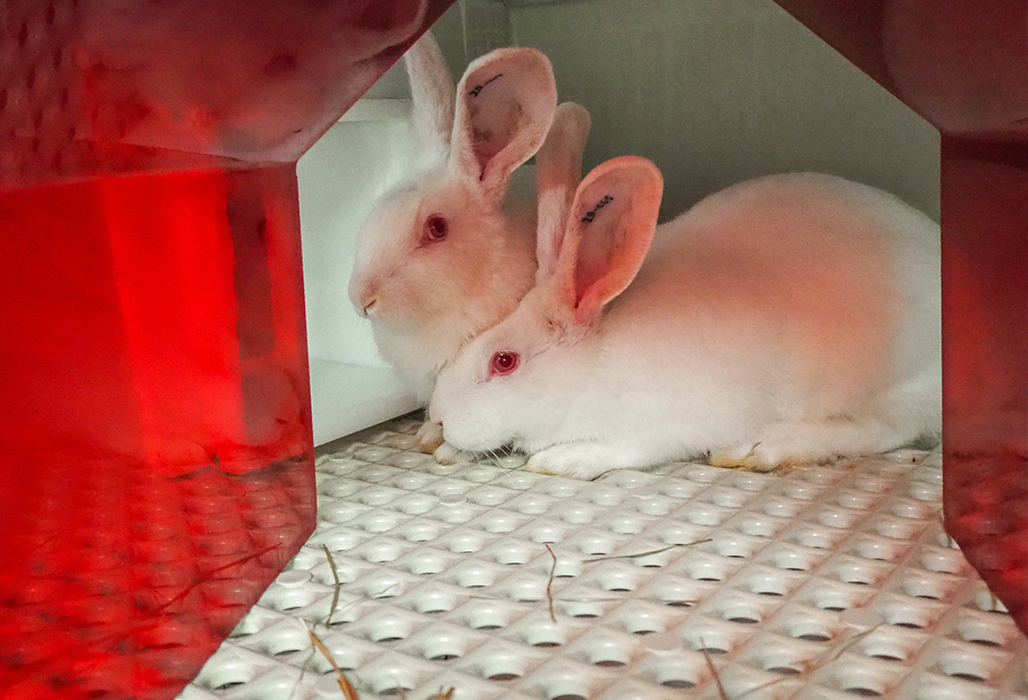
- The rabbit pyrogen test will be replaced by the end of this year.
- There will be an end to the use of animals in ‘Botox’ testing, but we are disappointed the ban will not be in place until the end of 2027. Shockingly, it is stated that, even then, on ‘rare occasions’ animals might still be used.
- Prioritise training in non-animal methods for early career researchers – even those who plan to use animals in their work.
- Whilst the report states in places that animal use is still needed, we completely disagree. We do however agree that ‘We are at a tipping point where international regulatory and political commitment, technological capabilities and scientific advances are converging to create a system capable of delivering the scientific, commercial, societal, economic and animal welfare benefits offered by alternative methods.’
It is disappointing that lethal dose animal tests (LD50 and LC50), the banning of which has been at the centre of our campaigns in recent years, and where non-animal methods exist, are not banned immediately. Instead of banning death as an endpoint, the report describes how for some tests, ‘evident toxicity’ might be used to replace ‘lethality’ in tests. However, this still involves a huge amount of animal suffering. The OECD describes ‘evident toxicity’ as occurring when one or more animals used in a test experience tremors, hypoactivity, irregular breathing or a weight loss of more than 10%.
It is also very disappointing, but not wholly unexpected, that the report has not used the same definition of a New Approach Methodology (NAM) as Animal Aid does. Our own roadmap explains that any NAM “should be ‘non-animal’ – containing no animal organs, cells or by-products”. Alarmingly, the report states that an ‘alternative’ rather than seeing the complete replacement of all animals, could be a method which uses ‘fewer protected animals’ than current methods. This definition is wholly unacceptable.
In the months following the election, it became clear that the Department for Science, Innovation and Technology (DSIT) were leading on this project, working closely with DEFRA and the Home Office. Not only did we send all three Ministers our roadmap, published last December, but Animal Aid has pushed (behind the scenes) for inclusion in the process of shaping the strategy, hosted a parliamentary roundtable and met with Minsters and MPs. To ensure the roadmap was as ambitious and progressive as possible, we called for:
- The diversion of funding from animal research to non-animal new approach methodologies.
- An immediate ban on lethal dose tests (LC & LD50) and all other experiments for which there are non-animal methods available.
- The establishment of a NAMs audit body, consisting of experts from all stakeholder groups, to identify NAMs already in use and those requiring development.
Animal Aid has been involved in contributing at many stages of this process. We will continue to hold the government to account and press for an ambitious and urgent replacement of all animals in laboratories.