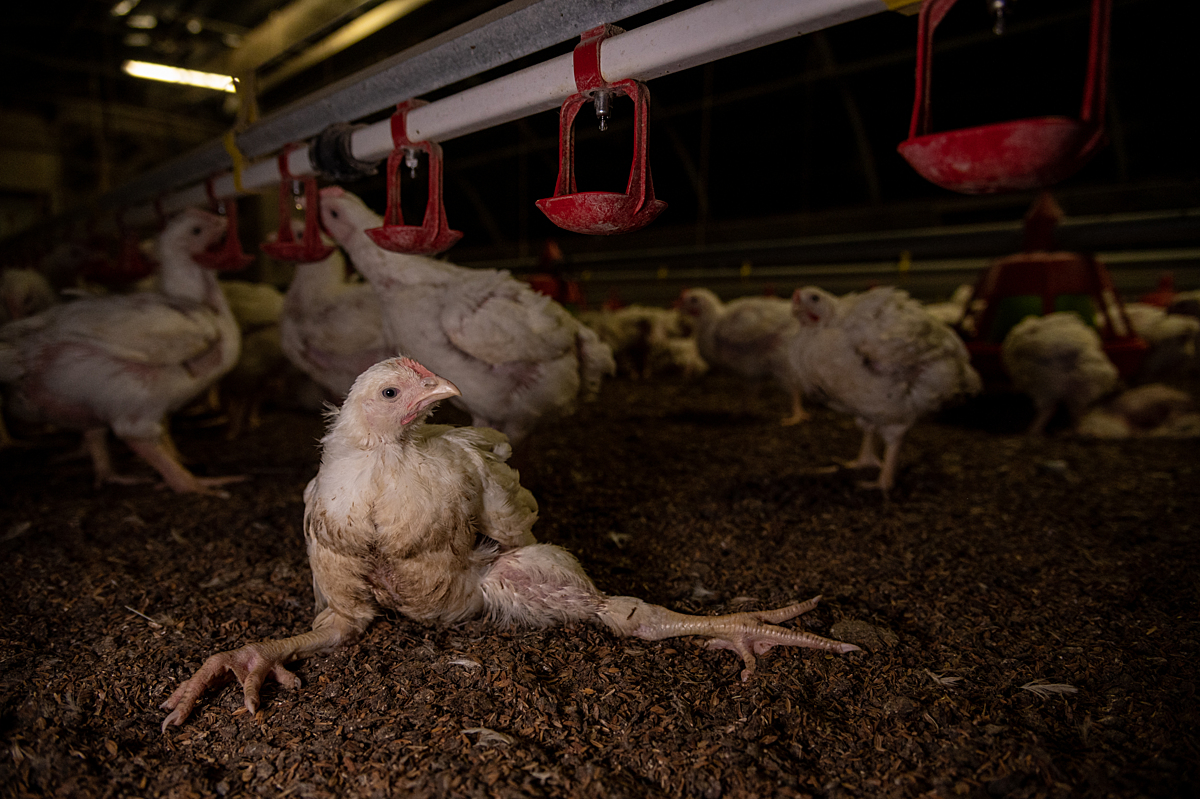
There is something surreal about watching Big Chicken: A Fast-Food Conspiracy. Netflix’s new documentary, presented by Mo Gilligan, sets out to investigate the rise of chicken as the fast-food industry’s meat of choice and, in doing so, gets tantalisingly close to the same points we campaigners have been making for decades. It takes us through a catalogue of harms from the consequences for environment and human health, the treatment of workers and local communities, and the extraordinary power wielded by corporations that have profited eye-watering sums of money from people’s appetite for cheap chicken.
It exposes a system that is anything but benign and yet, for all that it reveals, the documentary has remarkably little to say about chickens.
Perhaps this isn’t all that surprising. Industries that exploit animals are exceptionally good at making their subjects disappear: pheasants become game, beagles become test subjects, and chickens become fillets, nuggets, wings, burgers, and buckets. What’s unsettling about Big Chicken is that it sets out to expose an industry but manages to reinforce that industry’s own tactic of making chickens disappear. We see the body parts of chickens on Gilligan’s plate – as he challenges himself to eat fried chicken for 28 days – more than we see live chickens.
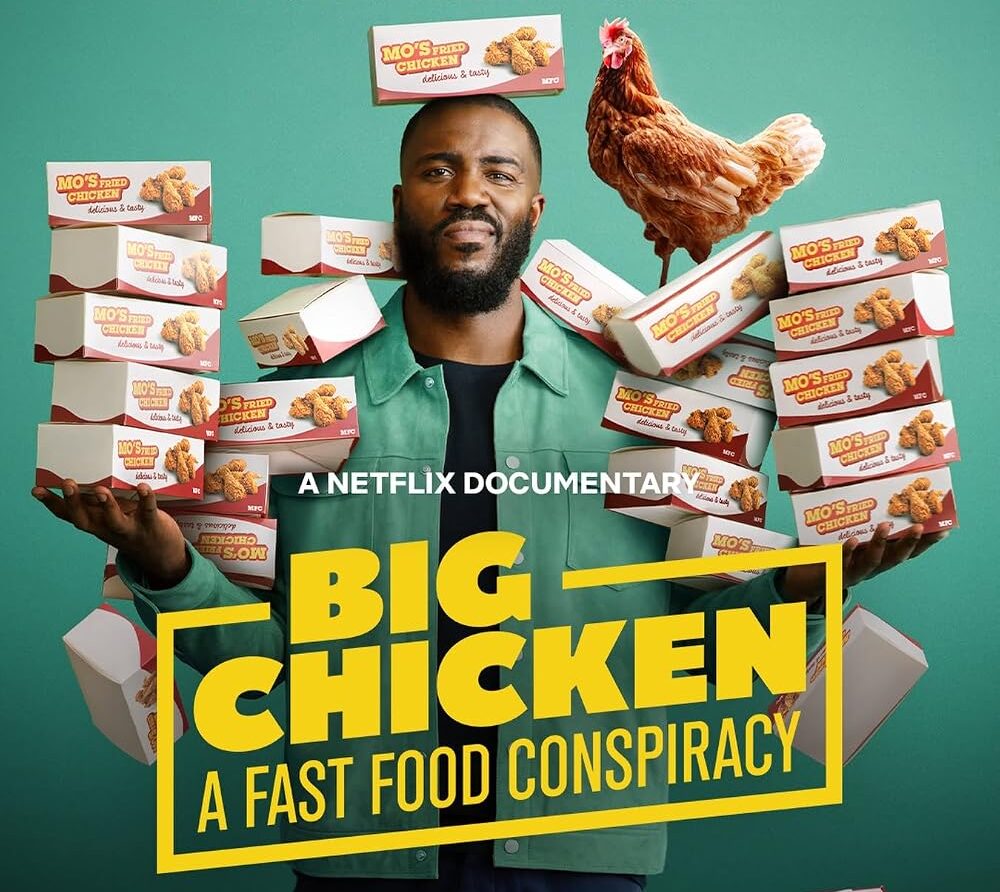
Trick question: How many chickens are in this photo?
Around the 78-minute mark, we’re taken inside a chicken shed and introduced to “Frankenchickens” – chickens destined for slaughter who have been selectively bred for such exponential growth that their bodies can no longer support their own weight. Here, Gilligan says “there’s a human part of you that says no animal should ever have to live and suffer like that” – but by minute 86 we’ve already moved on.
Even when the point is made that barns can become so saturated with ammonia – from the breakdown of nitrogen in the chickens’ faeces – that birds can lose their eyesight, this is framed through an anthropocentric lens. Ammonia is a human health risk, and the threat it poses to nearby communities should not be ignored, but the individual literally going blind for the sake of a bargain bucket is barely mentioned. What does it mean to him that all he’ll ever know is a fluorescent, fetid, noisy shed? How terrifying it must be to be grabbed by your legs, shoved into a crate, and not be able to look your abuser in the eye.
Big Chicken’s biggest mistake is using chickens as evidence of a problem, rather than the victims of one.
Photo: Animal Aid Investigation
Perhaps the documentary’s most egregious omission is its refusal to confront how chickens are killed. We see chickens alive and we see endless clips of Gilligan eating chickens, but nothing in between – there is no attempt to confront the fact that every wing, breast, or thigh eaten throughout the course of filming once belonged to a living animal. It’s a remarkable omission for a documentary investigating an industry whose entire business model depends upon killing billions of chickens every year. It’s possible that we have become so accustomed to the idea that animals exist to become food that even Big Chicken treats their death as an afterthought; an unquestionable, abstract part of the process not worthy of interrogating.
Of course, for chickens, death is not abstract nor instantaneous. By far the most common method of slaughtering chickens is gassing, accounting for 77% of chickens slaughtered in the UK. The alternative method involves shackling birds by their feet to a conveyor belt and moving them through an electrified water bath before a mechanical blade slices their necks. Perhaps if Big Chicken had been brave enough to include the chickens’ final moments, Gilligan wouldn’t have found it so easy to resume eating them once the cameras stopped rolling. But I guess we’ll never know.
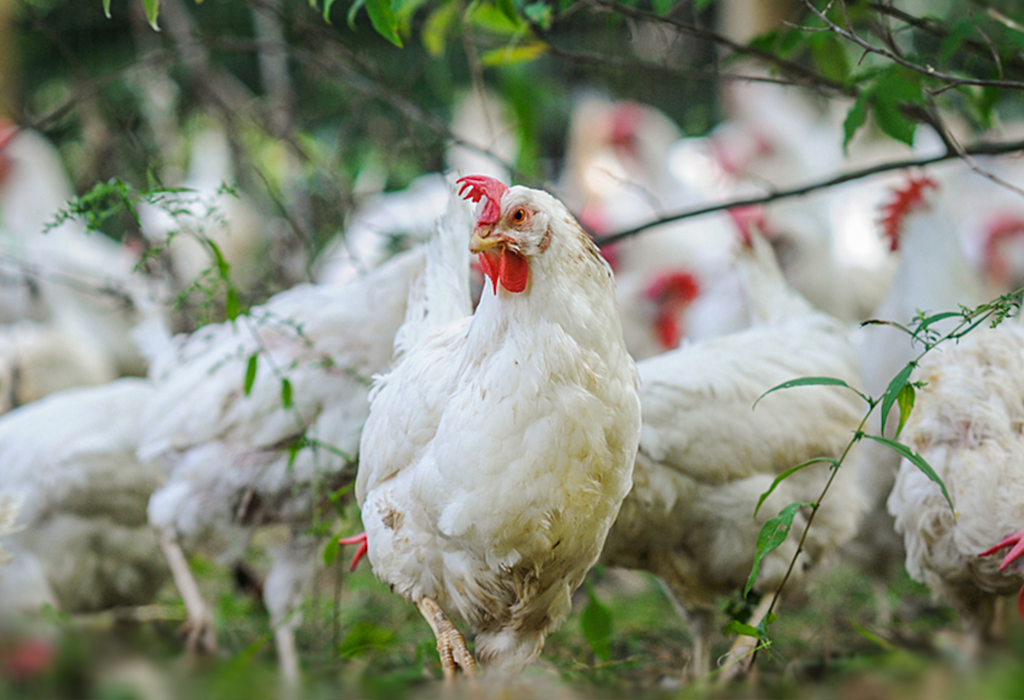
Photo: Jo-Anne McArthur / We Animals
Chickens are remarkably cool animals. They’re extroverts, explorers, empaths, and about as far from shrink-wrapped, anonymous white meat as you can get. The chicken industry doesn’t want consumers to see this side of chickens, and this is where Big Chicken takes an opportunity and squanders it. The documentary shows us the environmental damage, the risk to health, the exploitation of workers and communities. It shows us chickens whose bodies have been engineered for maximum productivity and even acknowledges, however briefly, that no animal should live or suffer like that.
Yet, right at the crux of the show, having brought us so close to the obvious conclusion, the documentary effectively “chickens out”. If only Big Chicken had been brave enough to ask the big question: why do we need to eat chickens at all?
Perhaps the reason lies in our reluctance to say the word vegan. That to bring people into our movement, we must first make ourselves more palatable, moderate, mainstream (after all, it doesn’t get more mainstream than Netflix). But if we are serious about changing the world for animals, we can’t let the animals themselves disappear. Big Chicken shows us almost everything that is wrong with the chicken industry but stops short of concluding that the most obvious solution is to just stop eating chickens. Like the documentary, we need to be a less afraid of confronting the truth and a little more willing to follow the argument wherever it leads.