
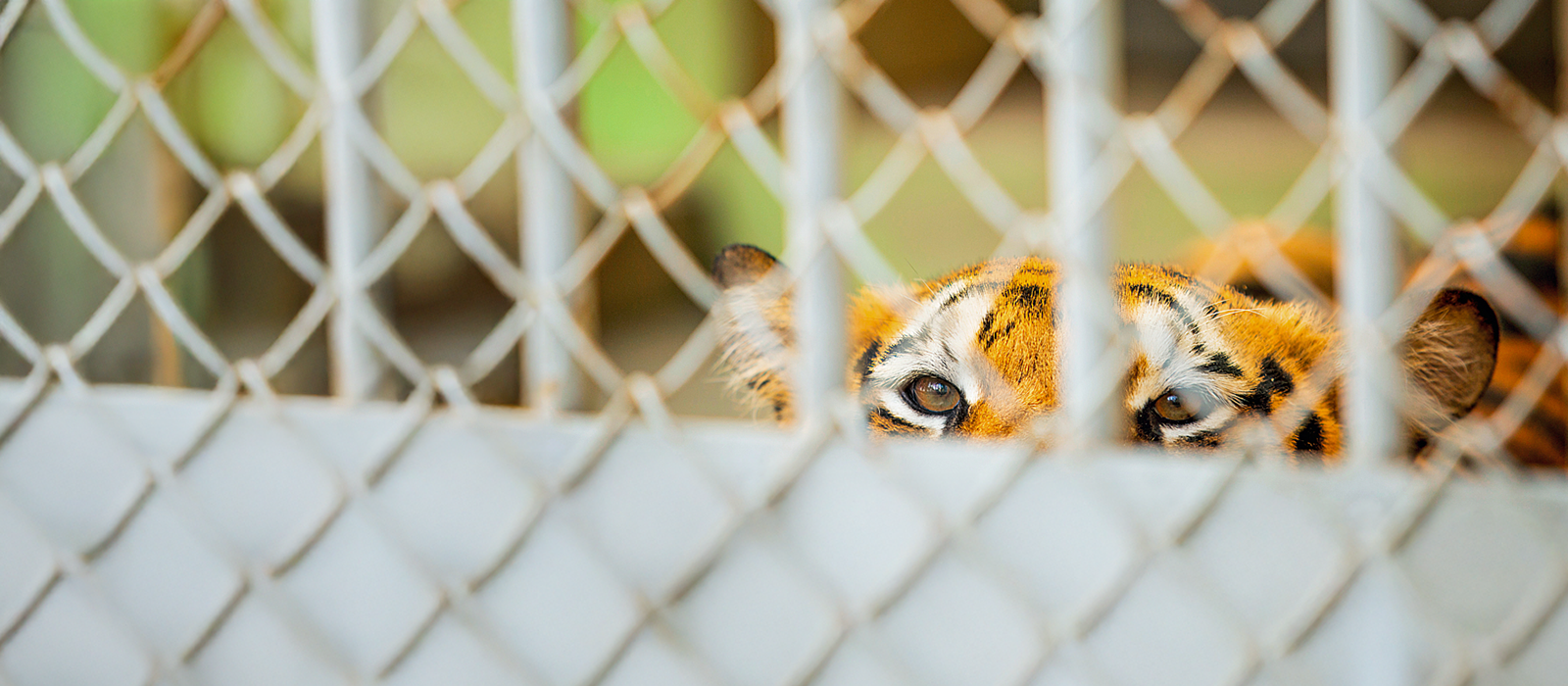
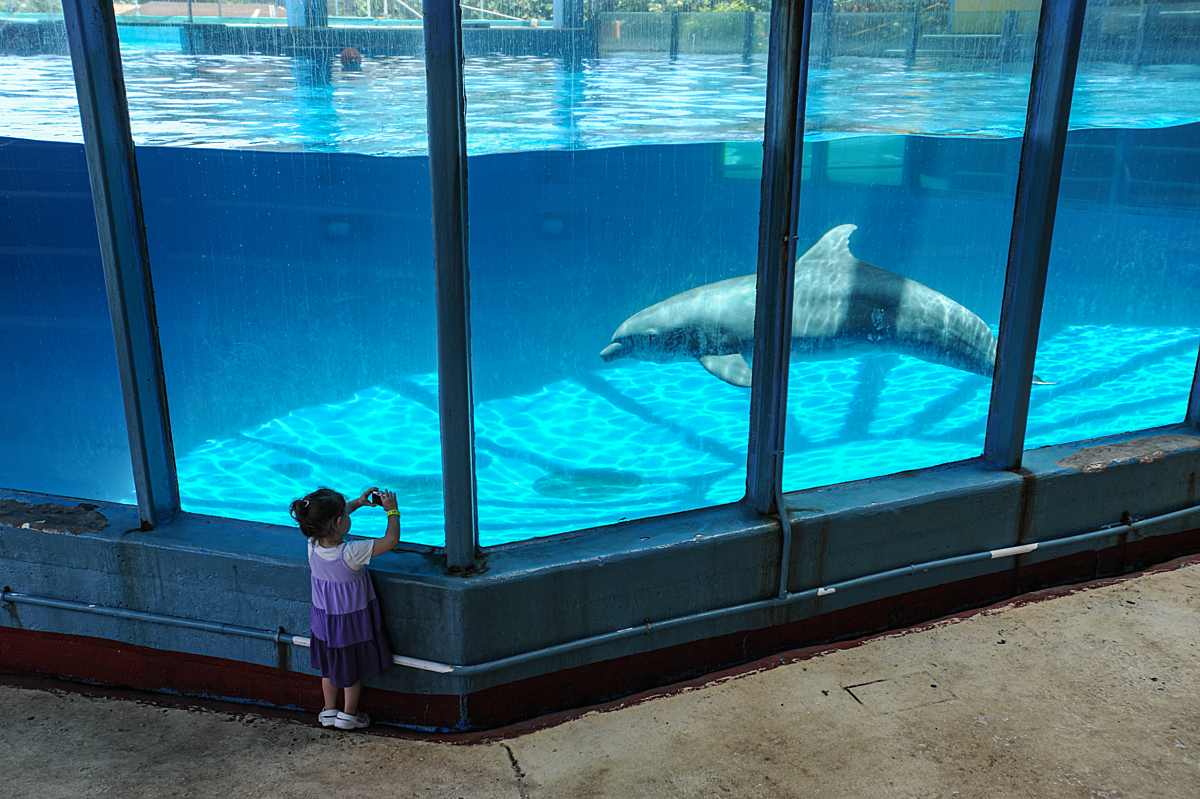
Zoos hold animals captive after stealing them from the wild or, more commonly, by breeding them. Animals in zoos are ‘exhibits’ on display, used to lure in the public and make money. Likewise, aquariums are places of immense deprivation, with animals stolen from the ocean and confined to tiny, unsuitable tanks.
Most people visit zoos and aquariums because they are interested in animals and don’t realise the cruelty that goes into keeping their doors open. In fact, these places do an excellent job of misleading the public, rebranding themselves as ‘safari parks’ or ‘conservation’ – in reality, they are businesses that exist to make money.
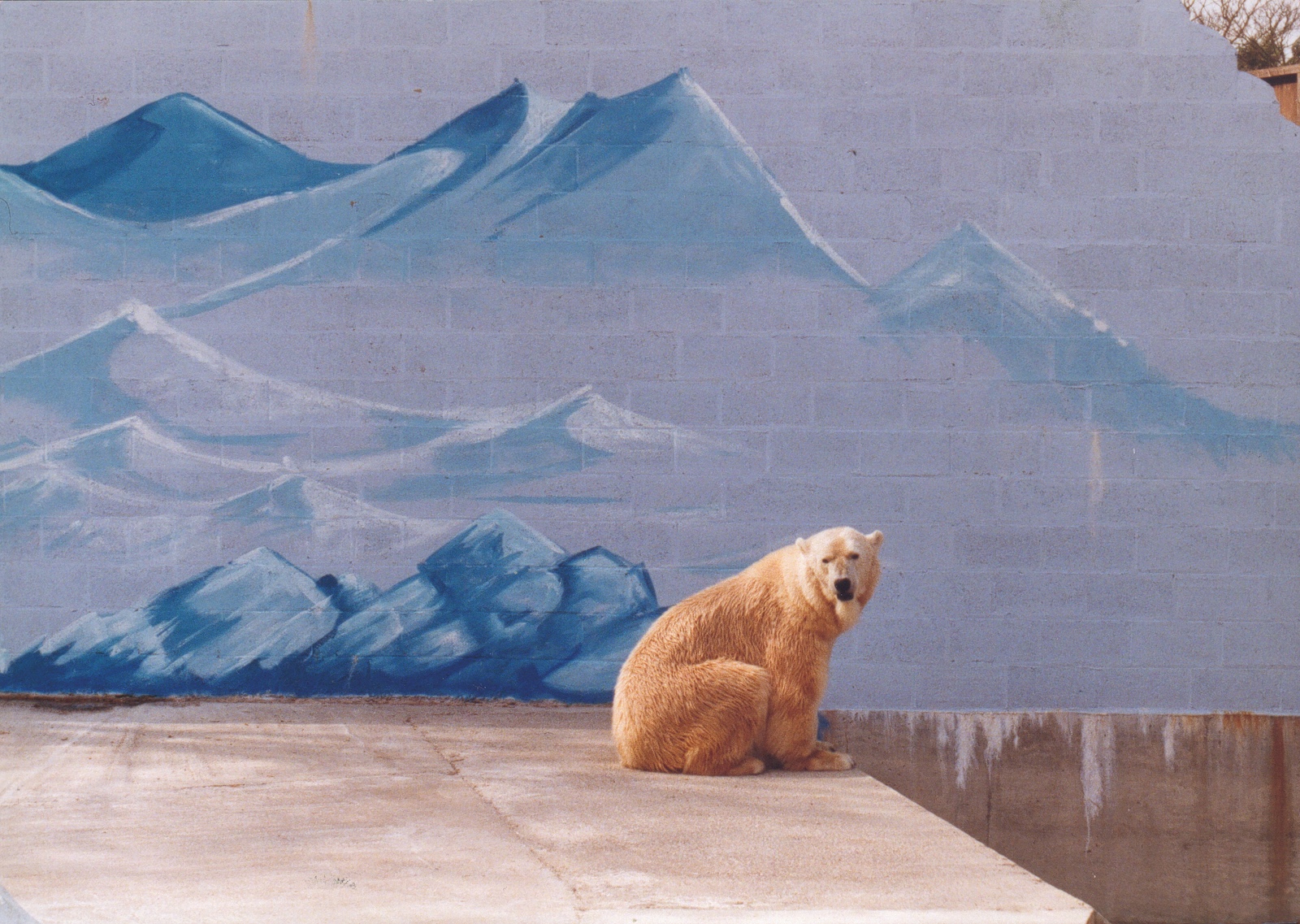
Photograph by Freedom for Animals (formerly Captive Animals Protection Society)
Despite the thousands of people who peer at them every day, the suffering of animals confined to zoos and aquariums across the UK is largely unseen.
Enclosures are always unsuitable because they will never be able to replicate the rich, diverse habitats of the wild. Zoo enclosures are cramped, dirty and devoid of any enrichment. This can lead to sickness, with animals dying in UK zoos every year, and mental distress that manifests in repetitive behaviours like pacing, swaying their head from side to side, and even self-mutilation.
Animals in zoos are severely restricted in their behaviours and lack any control over their environment (light, temperature and noise are all dictated by humans), feeding times or social interactions.
This lack of agency leads many animals in zoos to suffer a condition known as ‘learned helplessness’. This is where individuals become passive and unresponsive following prolonged exposure to a negative experience they are unable to control, avoid or escape. They ‘learn’ that their situation is hopeless and they are powerless to change it.
Zoos and aquariums are profit-driven businesses. They meet the ‘demand’ for animals through a series of questionable tactics like trading animals with other zoos to ensure a constant supply of ‘new exhibits’ (tearing families apart in the process) and breeding baby animals to drum up public interest. Lion cubs at Longleat Safari Park were killed after the zoo let inbreeding get out of control, admitting that the ‘deliberate expansion of the lion population…was to ensure there were always cubs on view for visitors’.
Healthy animals are sometimes killed simply because they are no longer wanted, like the 20 ‘surplus’ Guinea baboons set to be culled at a German zoo because overpopulation (because of the zoo’s breeding programme) has led to their enclosure becoming overcrowded, resulting in fights and injuries. Their bodies will feed other animals at the zoo.
- There are more than 300 licensed zoos in the UK holding tens of thousands of animals captive.
- Public zoos must have a licence to operate, but 75% of inspections found unsatisfactory issues that were not addressed.
- Big cats like lions and tigers have around 18,000 times less space in zoos than they would in the wild. Polar bears have one million times less space.
- 486 animals died at South Lakes Safari zoo in just 4 years – local authorities allowed the zoo to continue operating.
- An investigation by the BBC found that 4,500 individuals died at Sea Life aquariums, owned by Merlin Entertainments, in a single year.
- Compared with zoos and safari parks, which largely breed animals in captivity, aquariums steal animals from the wild. An estimated 79% of animals are taken from the wild to stock UK aquariums, even from ecologically sensitive areas like the Great Barrier reef.
- 76% of British zoos failed to meet at least one basic requirement for health, housing or treatment of their animals.
- In 2015 an ‘after-hours’ zoo event had to be cancelled after a guest reportedly poured beer over a tiger – but not for long, as London Zoo is hosting a series of events “for adults” this summer where paying guests can drink alcohol and listen to live music.
Most people don’t visit a zoo or aquarium with the intention of funding animal abuse. But the zoo industry has deliberately misled the public by rebranding itself as necessary for ‘conservation’. They tell us their work protects animals who are endangered in the wild – but this couldn’t be further from the truth.
In fact, most animals confined to zoos aren’t threatened in the wild. One example is meerkats, who are found in most zoos but not endangered at all. What is the purpose of breeding them if not for entertainment? The fact that many zoos offer meerkat ‘experiences’, where you can meet the animals and feed them for an additional fee, is probably the answer.
Of the endangered animals that are bred and held captive in British zoos, few make it back to the wild. In fact, no British zoo has successfully released tigers, elephants, chimpanzees or many other species into the wild. And why would they? Visitors won’t pay to see empty enclosures, so it makes good business sense to keep the cages full.
These places also fail as an educational tool: there is no evidence that zoos and aquariums promote an attitude change in their visitors or interest in conservation. A Freedom for Animals study of British aquariums found that 41% of animals on display didn’t even have information boards.
And, finally, animals in captivity suffer reduced motivation to forage for food, search for a suitable mate or find a safe home; their entire lives are artificial, from birth to death. What use is it to learn about wild animals while staring at an animal who has only ever known captivity?
Safari parks: The ‘higher welfare’ sham of zoos
In response to growing public awareness and concern for animals in captivity, zoos have given themselves fancy new names: safari park, wildlife park, zoological garden, sanctuary. However, they still breed, trade and imprison animals for profit, making them identical in all but name.
Safari parks may boast larger enclosures but they still:
- Breed animals when they shouldn’t. Blair Drummond Safari Park in Scotland bred chimpanzees despite research showing that captivity literally drives chimps mad.
- Let animals die through sheer negligence. In 2022 twin red panda cubs froze to death at Longleat Safari Park.
- Kill healthy animals. Longleat Safari Park is also guilty of killing lions and lion cubs after the zoo let inbreeding get out of control, admitting it did this deliberately ‘to ensure there were always cubs on view for visitors’.
- Confine animals to tiny enclosures. Freedom for Animals found Woburn Safari Park confining animals for up to 18 hours a day, dispelling the myth that safari parks offer animals greater freedom.
- Prop up the entertainment industry. Port Lympne Wild Animal Park and Knowsley Safari Park have both been found hosting ‘after-hours’ events or events where animals are made to perform tricks. West Midland Safari Park was even exposed for giving white lion cubs to a notorious circus trainer, who sent them to a travelling circus in Japan.
Keeping animals in captivity does nothing for conservation. Nor does it inspire or educate visitors. Either way, keeping animals in captivity against their will is indefensible. Industries like zoos and aquariums operate without transparency, allowing tens of thousands of animals to die each year – all in the name of entertainment.
Take action for animals exploited for entertainment
There's nothing entertaining about exploiting animals. Take action today for a kinder tomorrow.