
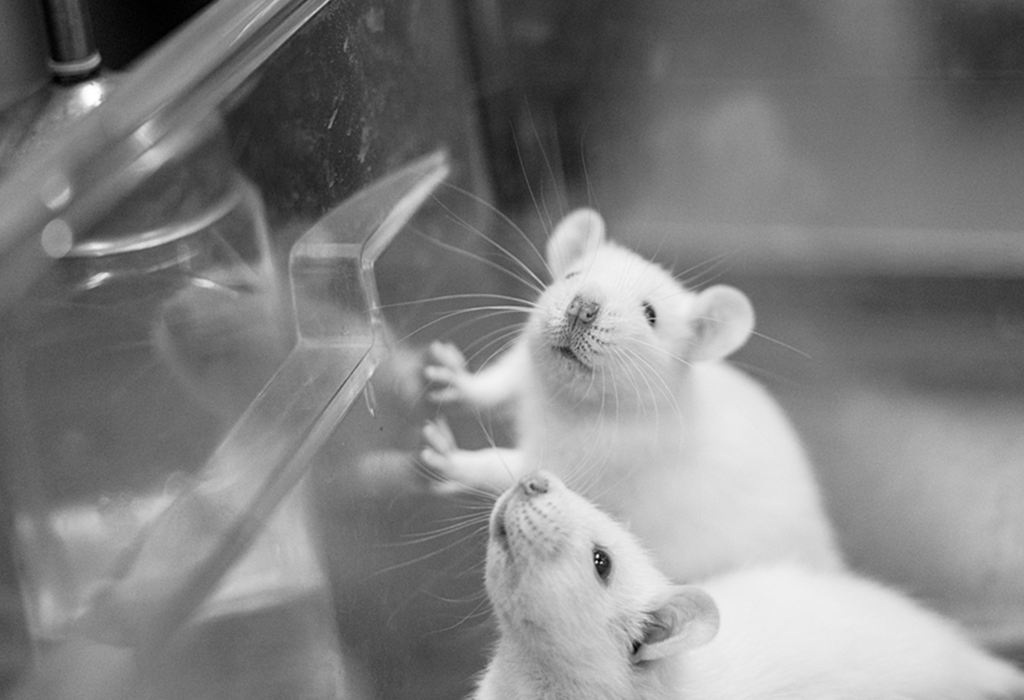
Regulated procedures are anything that ‘may cause that animal a level of pain, suffering, distress or lasting harm equivalent to, or higher than, that caused by inserting a hypodermic needle’, according to the Home Office. This is a broad definition that is difficult to compare to an injection. Some examples of regulated research include acts of:
- Commission, such as dosing or sampling
- Omission, such as withholding food and water
- Permission, such as breeding animals with harmful genetic defects.
Despite researchers’ legal requirement to follow the 3Rs (replace, reduce, refine), this does not apply where doing so would impact the research. For example, animals only receive pain relief where it does not interfere with the research being carried out.
Non-regulatory procedures are those that are not required by law. They are usually conducted in an attempt to answer a scientific question about a disease or to try to recreate a human disease in an animal. They might also be done for ‘forensic enquiries’ or for ‘education and training’.
No. Only a small proportion of procedures are required by law, mainly for safety testing and product development.
Home Office guidance lists ‘basic research’ as one reason for conducting experiments on animals – the purpose of ‘basic research’ is simply to obtain knowledge, and it is largely carried out in universities. In 2020, 54% of all experiments were carried out in universities and medical schools, but these statistics are no longer shared publicly.
Our Universities Challenged campaign sheds light on which universities use student tuition fees to needlessly harm animals in non-regulatory research.

Take action for animals in laboratories
There is no justification for harming and exploiting animals when cruelty-free science is possible. Ask your MP to strengthen the Government’s animal testing strategy