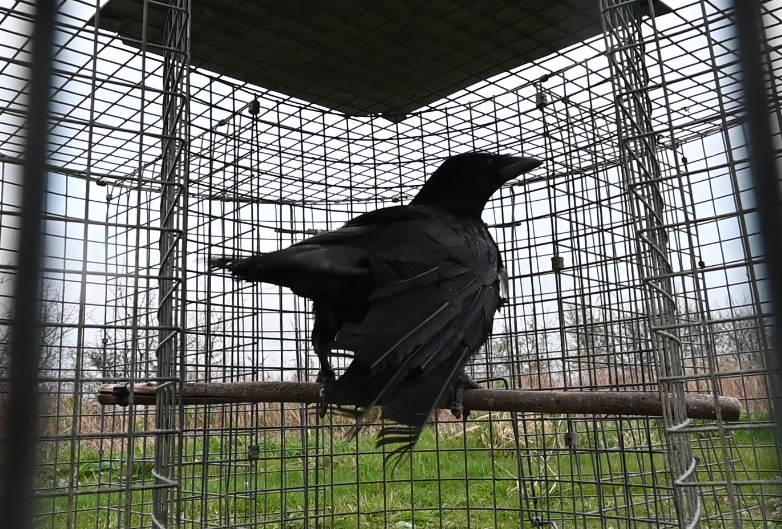
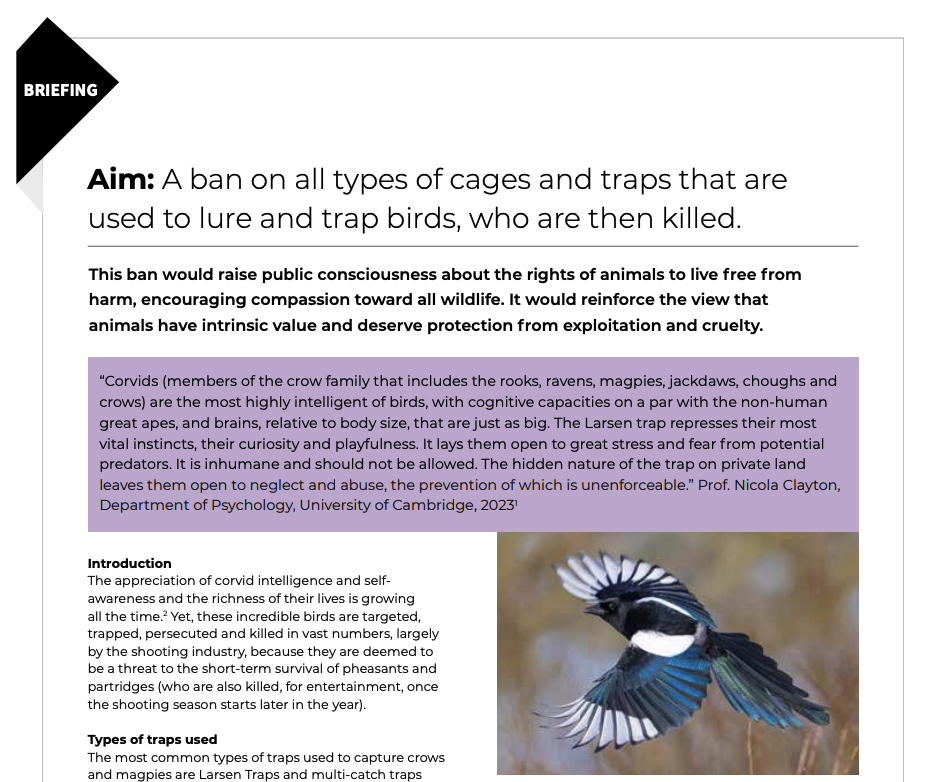
Corvids – crows, ravens, magpies and jays – are amongst the smartest animals on Earth. They can solve complex problems and use tools, but they’re also incredibly social, forming strong bonds and even remembering who’s been kind to them!
Yet across the UK, these remarkable individuals are imprisoned inside bird traps, such as Larsen or Ladder traps, also known as multi-catch traps.
Larsen traps have a compartment where a live ‘decoy’ bird is trapped. Confined and distressed, their cries attract other birds who are territorial or inquisitive and unknowingly enter the main part of the cage, becoming trapped themselves.
Ladder traps are typically baited with either a decoy bird or food to lure other unsuspecting birds into the cage, where they will be trapped and unable to escape. When the gamekeeper returns, the birds are killed.
We believe no bird should be used as bait.
All traps used to imprison animals are cruel and unnecessary but to deny birds their ability to fly is an especially profound form of cruelty.
- Despite the stress, it’s entirely legal to incarcerate a wild ‘decoy’ bird in a cage.
- Incarceration causes stress and trauma to the wild ‘decoy’ bird, and the other lured birds, who may injure themselves trying to escape.
- The capture of adult birds during the breeding and nesting season means many hatchlings and fledglings are orphaned and may not survive.
- The traps are set at ground level and expose the birds to the trauma of prowling predators.
- The traps may indiscriminately catch other animals and other birds.
- ‘Decoy’ birds are often found dead through neglect or starvation.
- Trapped birds may be forced to watch as other birds are killed by the gamekeeper, causing immense psychological distress.
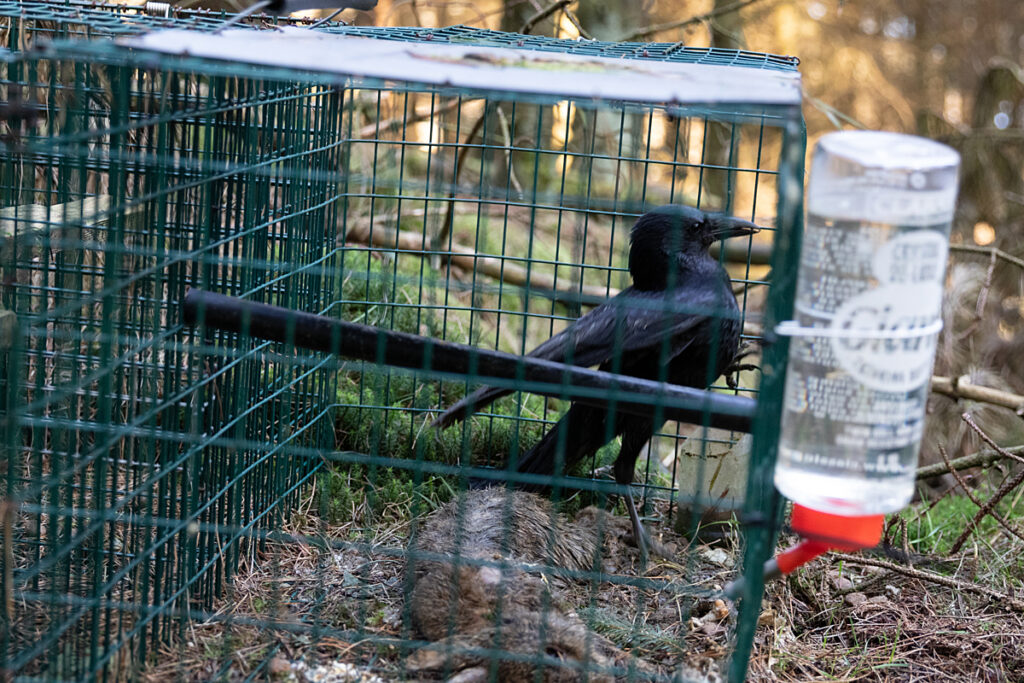
A crow confined to a Larsen trap on a Yorkshire shooting estate. Credit: Craig Redmond / We Animals.
Traps are set under the conditions of a General Licence, but since no paperwork is required, there is no way to check that even the most basic criteria is being adhered to. For example, ‘decoy’ birds must:
- be provided with a perch, fresh water and suitable feed
- be protected from pain, suffering, injury and disease
- be provided with shelter from wind, rain and sun
- not have their wings clipped
- and be killed ‘humanely’.
In addition, traps should:
- not be used in severe weather conditions or when bad weather is anticipated
- be inspected every 25 hours and any dead birds or animals must be removed
- and be set to minimise the trapping of non-target species.
This might be the law, but we know from our investigations that laws designed to protect animals are rarely sufficient or enforced. Where oversight fails, cruelty thrives.
Animal Aid has documented the suffering of birds used as ‘decoys’ to lure others, as well as the suffering of birds who are subsequently trapped.
We always report our findings and any breaches of legislation to the relevant authorities, but this usually results in little more than a verbal warning, demonstrating a clear lack of concern for these brilliant birds and supporting the case for a ban.
- In 2017, we found birds trapped without access to water, and a Larsen trapped illegally baited with a live red-legged partridge, at Heart of England Game Farm.
- In 2018, at Chargot Estate, investigators set up a long-run camera that recorded continuously for 44.5 hours. A rook had been left in the trap for the whole duration without water or a perch.
- Later in 2018, we filmed two Larsen traps at Bonson Wood Game Farm and recorded temperatures reaching 28C. One trap was not inspected for almost 35 hours while birds were distressed, injured, and without water.
- In 2021, at The Norfolk Estate in West Sussex, an injured bird was being used as a ‘decoy’ and his water bowl had frozen over.
- In 2025, Animal Aid investigators found a crow and magpies confined at Bryn Coch Game Farm.
See our investigation footage from Bonson Wood below.
In 2025, Animal Aid patron Chris Packham launched our Killing our Countryside campaign, which calls for a total ban on the production and ‘sport’ shooting of live birds for entertainment.
The detailed Killing our Countryside report examines the widespread impact of shooting on wildlife, waterways, and the environment. But we’re not stopping there: our anti-shooting campaign is taking on the bold new challenge of banning these cruel and indefensible bird traps.
Learn more about the campaign and get involved.
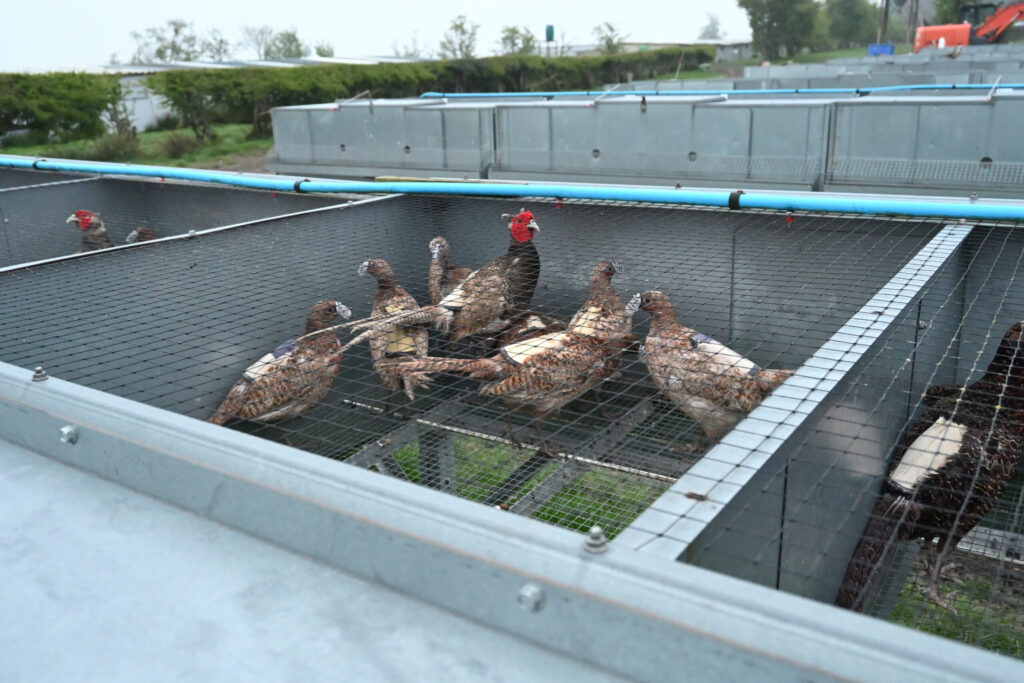
Pheasants and partridges suffer at the hands of the shooting industry. So too do wild birds and rural habitats.
Every day that these traps remain legal, wild birds are confined, frightened, and used as weapons against their own kind, forced to lure other birds to their deaths.
If you agree that creatures born to fly deserve freedom and respect, then please stand with us as we demand a ban on bird traps.