The True Cost of Cheltenham
Eight jockeys have received sanctions for abusing horses with the whip during the course of 2026’s Cheltenham Festival. The British Horseracing Authority (BHA) allows jockeys to whip horses up to seven times during a jump race – which is obviously a horrific thing to do to an animal. Eight jockeys were not satisfied with this limit, and broke it up to two times. This totalled 67 beatings with the whip delivered to just eight of the hundreds of horses who were forced to run last week. The BHA has ruled on these cases, handing out suspensions of only days or weeks, and a couple of fines. But none of this undoes the hurt caused to those horses.
One of the horses abused was Salver, who ran in the 14:00 race on Wednesday. He was seen to be struggling before the race even began and had to be checked by vets before being cleared to start. His jockey, Caoilin Quinn showed no empathy for the poor animal whose body was in his hands and whipped him 8 times to force him into a third-place finish and a prize of £21,856.60 for his abusers. The BHA even reduced the penalty for whip abuse in recognition that Quinn had gone 150 rides without breaching whip regulations and handed him a suspension of only 4 days.
Of course, there has been no action taken against jockey Harry Cobden, who shouted at, dug his heels into, and struck his horse, Tutti Quanti on the opening day as the poor animal was reluctant to approach the starting line. The whole Cheltenham Festival was widely reported as a disorganised farce, and this continues into the industry’s failure to address the behaviour of its jockeys. The fact is, that horses are exploited and abused whenever they are forced to race, and profit is prioritised over their lives, bodies, and rights.
————————–
Updated 19th March
————————–
Cheltenham Festival 2026 was characterised by chaos and violence off and on the track. From fights breaking out across the spectators’ areas, to a jockey being accused of racial abusing another, and race after race being marred by disorder at the starting line leading to agitated and stressed horses, the festival was a spectacle of atrocious behaviour. Of course, the worst of it had innocent victims – the horses who suffered the carnage of the four-day debacle.
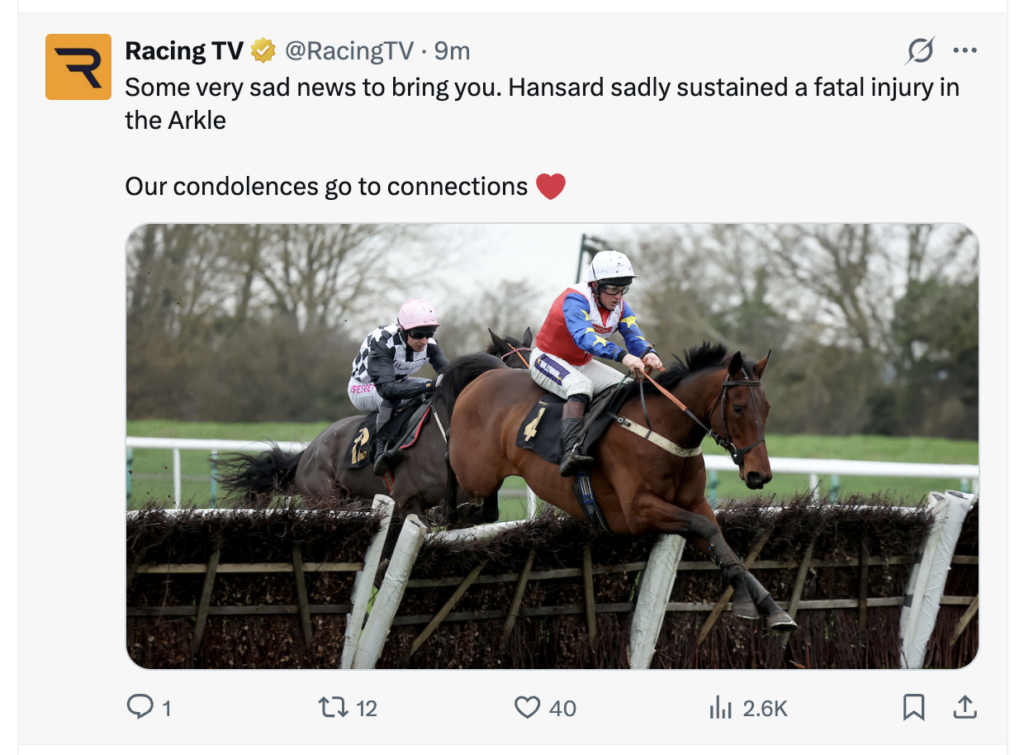
Death opened the festival and closed it. Hansard was a bay horse who had just turned eight years old in February. The Singer Arkle Challenge Trophy Novices’ Chase on the opening day was his 21st race and it was also his last. He got to the home stretch before he was ‘pulled up’ for an injury that it was confirmed shortly after had led to the decision to kill him. Hansard’s lifetime of racing had earned his abusers over £200,000 over four years. Now that he’s been killed, they will simply replace him with another victim.
HMS Seahorse became the second horse to die on Wednesday. He had also just turned eight years old. He fell at the final hurdle of the BetMGM Cup Handicap Hurdle and “could not be saved” according to a Cheltenham spokesperson. That is fundamentally incorrect. HMS Seahorse and every single one of the thousands of other horses who have died on racecourses could have been saved if they had not been forced to race. Death and injury are predictable outcomes of dangerous practices. The solution is simple: abolition.
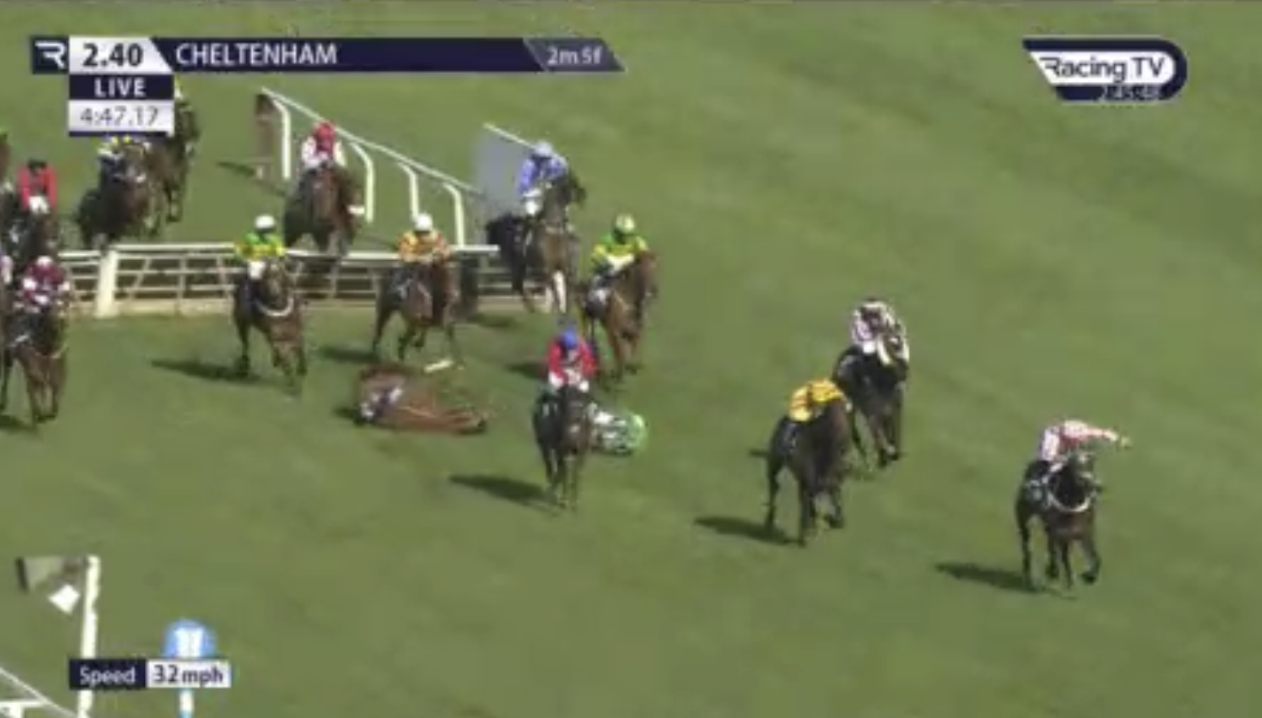
HMS Seahorse fell at Cheltenham on Day 2 and was killed shortly after.
On the final day, in the Gold Cup race, it looked like all the horses had survived. However, not long after the race concluded, word broke that Envoi Allen had collapsed on the way back to the paddock and died. He was much older than most other horses in the festival at 12 years old, and was scheduled to retire following the race. His death was attributed to a cardiovascular issue – a predictable result of running a horse of that age in such a difficult race. Later that day the festival ended, characteristically, in death, as Saint Le Fort fell at the final hurdle of the final race and was killed on the track by attending veterinarians. It was the day before his sixth birthday. He was barely mentioned in coverage as his death was reported after the festival had closed.
In all of these cases, as the ‘winners’ were celebrating, those who had fallen were being put to death. The Jockey Club labelled these kinds of killings as ‘humane euthanasia’. There is nothing merciful about killing someone to relieve the suffering that you inflicted upon them in the first place. The festival released a copy and paste sentiment “our heartfelt condolences are with his connections”, consoling those who had profited from their ‘careers’ whilst saying nothing of the fear and the pain the horses had endured. The horses are the victims, and it is the duty of compassionate people to remember them, act on their behalf, and end horse racing.
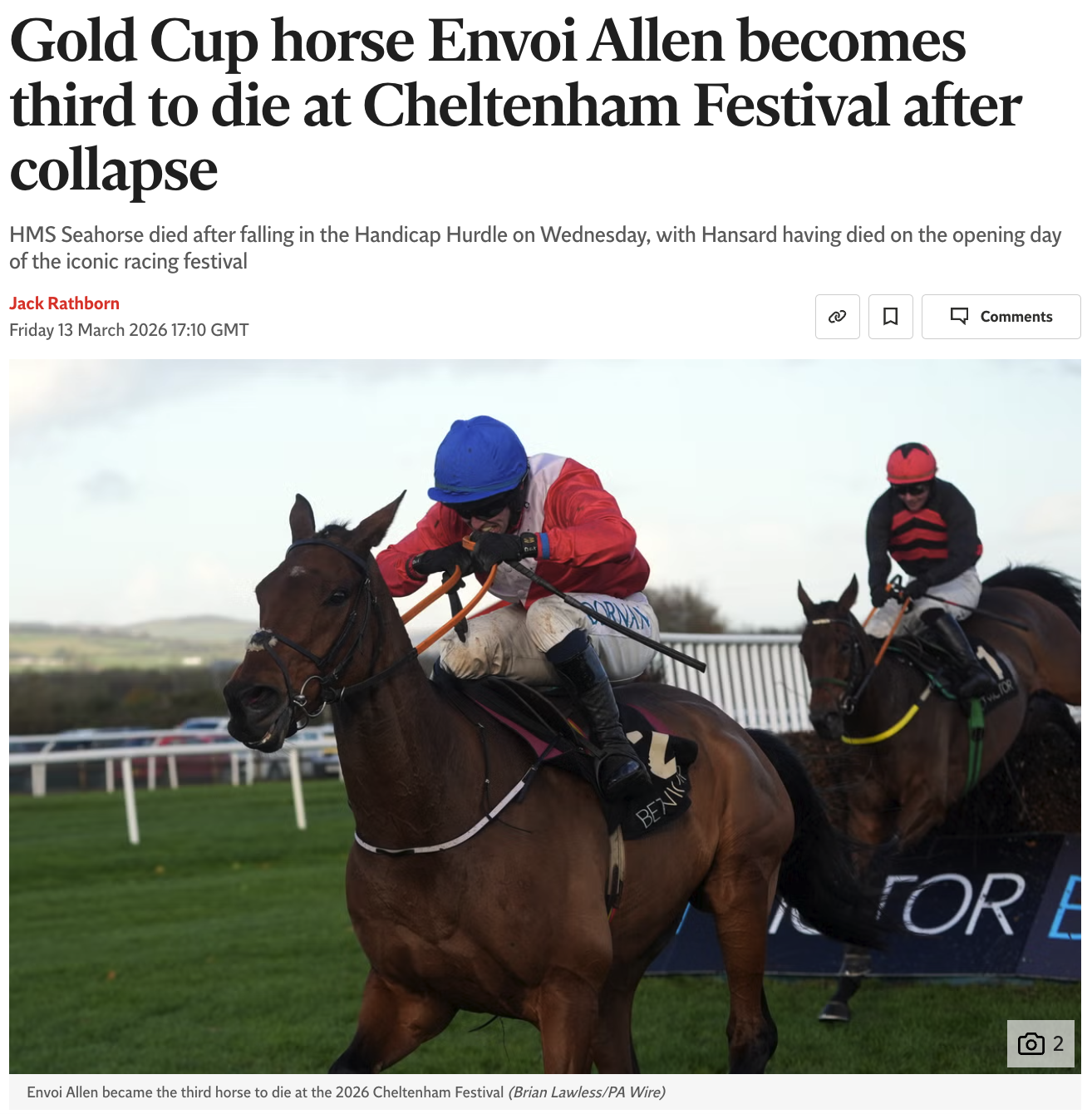
Envoi Allen was considerably older than most of the other horses at the festival. He could be seen struggling yet was forced to finish, and died only moments later.
Horse racing is a practice that has been struggling for a long time. Media throughout the week has referred to Cheltenham Festival as a welcome break from the ‘Civil War’ that’s breaking out within the industry. The BHA chair has recently resigned after only 6 months in post, and as executives argue with each other endlessly over their futures, and the PR team throws everything into creating a new mythology to attract new punters, it’s very clear that the industry insiders don’t believe their own hype. Over the course of Cheltenham Festival complaints about constant botched starts and video footage of multiple brawls amongst attendees flew in the face of the idea of the ‘sport of kings’. And whilst the BHA put out statements and social media claiming the horses are happy and excited to race, ITV presenters consistently spoke about horses who were nervous and wearing all manner of equipment to try to calm them down before a race.
For a ‘sport’ that can’t even figure out how to start races, it’s up to us, the compassionate public, to figure out how to end them. Animal Aid monitors horse racing every day – not just the ‘big festivals’ – and we record and publish all of the known names of the innocent individuals who lose their lives to it. There are thousands of horses trapped within the industry right now and every year thousands more are bred to join them, replacing those killed both on the racecourse and off it. Racing can’t figure out its next steps as the in-fighting continues and the profits decline.
For a dying practice, the kindest thing now is to put it out of its misery – boycott racing and end it forever.
Put the racing industry out of its misery
The easiest way to protect horses is to boycott an industry who consistently puts them in danger. Please pledge to never attend or bet on horse racing.