
Ending Greyhound Racing one track at a time
The UK's oldest dog track didn't survive to see its 100th birthday this year - here's how activists ended its reign of cruelty.
The rise and fall of greyhound racing
Greyhound racing is not a ‘proud British tradition’ like the industry claims; it was imported from the US a century ago. Although greyhounds are one of the world’s oldest breeds, first recorded thousands of years ago, racing them is a fairly new practice – one that we are fighting to consign to history.
When Belle Vue Greyhound Stadium opened in Manchester in 1926, it was the first of its kind. Based on an American model, the oval track with a mechanical hare had never before been used in the UK. The site became the home of the newly formed Greyhound Racing Association (GRA), who quickly opened two more sites in London. Many more were to follow, but their popularity only lasted a few decades – closures began in 1960 and continue to this day, with the most recent running their last race in Swindon on the 27th of December 2025.
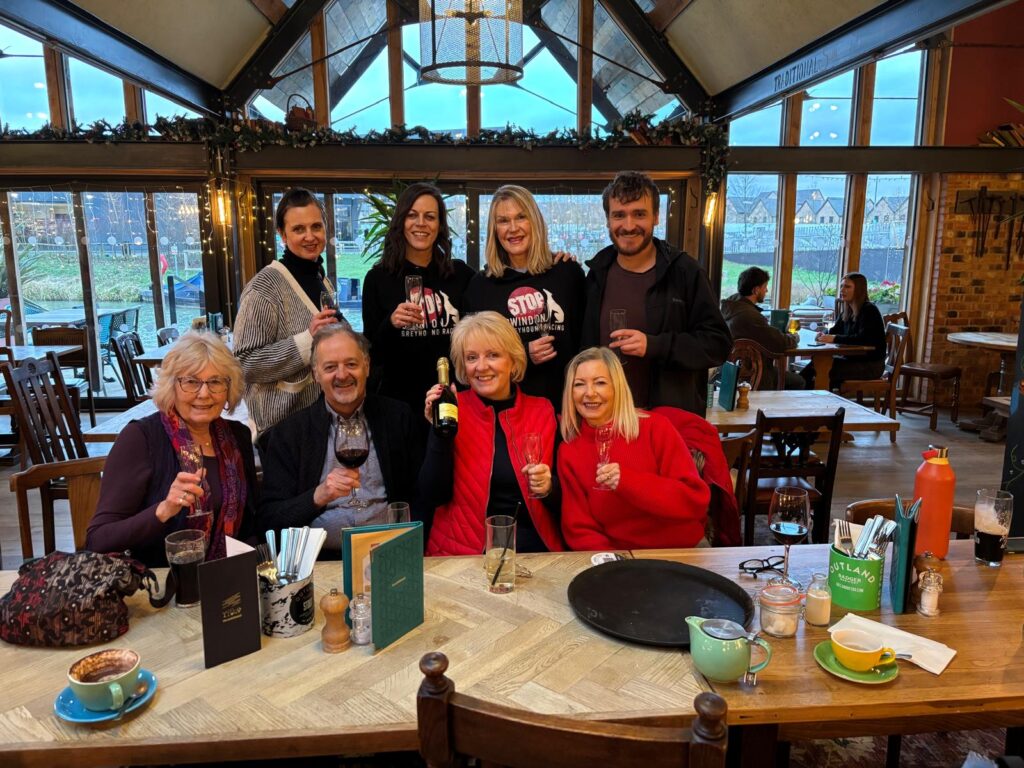
Activists in Swindon celebrating the closure of its stadium last month, after years of tireless campaigning.
Closing Belle Vue
Throughout the short history of UK greyhound racing public opinion on the treatment of animals has shifted considerably. Growing public discomfort at the injuries and death suffered by dogs forced to race was among the factors that led to the closure of 91 greyhound racing tracks between 1960 and 2010. Despite this, Belle Vue Greyhound Stadium, the industry’s seat of power, clung on. However, its opponents were determined to see it close, and by 2021, they would achieve what they set out to do two decades previously.
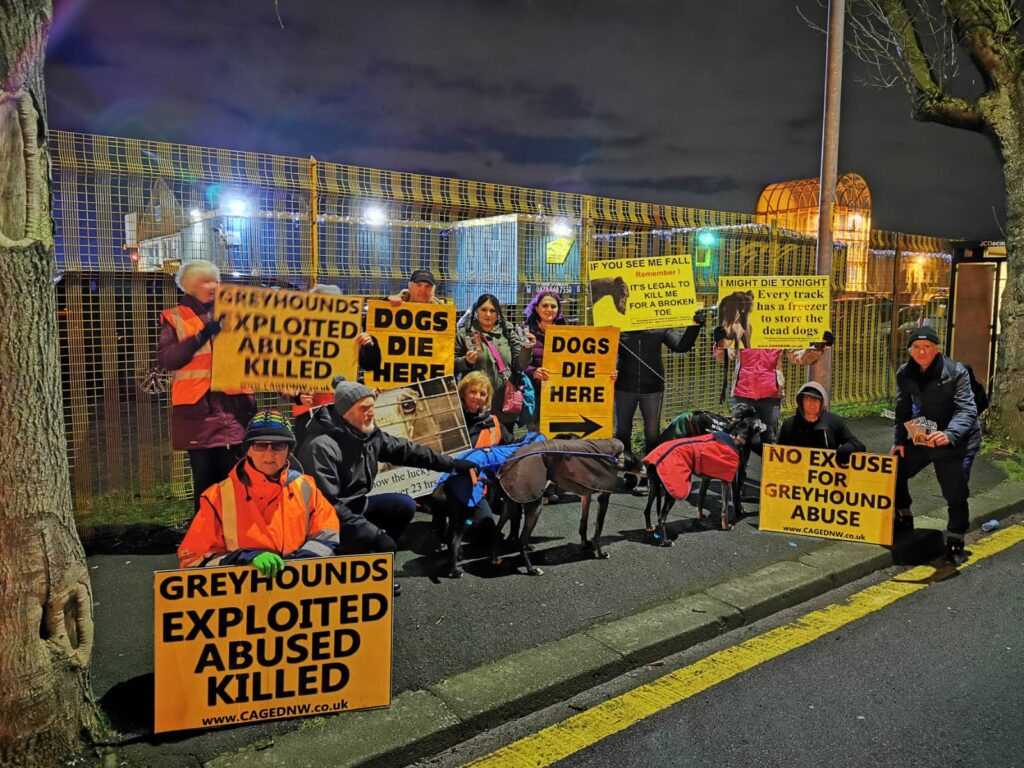
They didn’t know it yet, but this ordinary night at Belle Vue was the last ever protest.
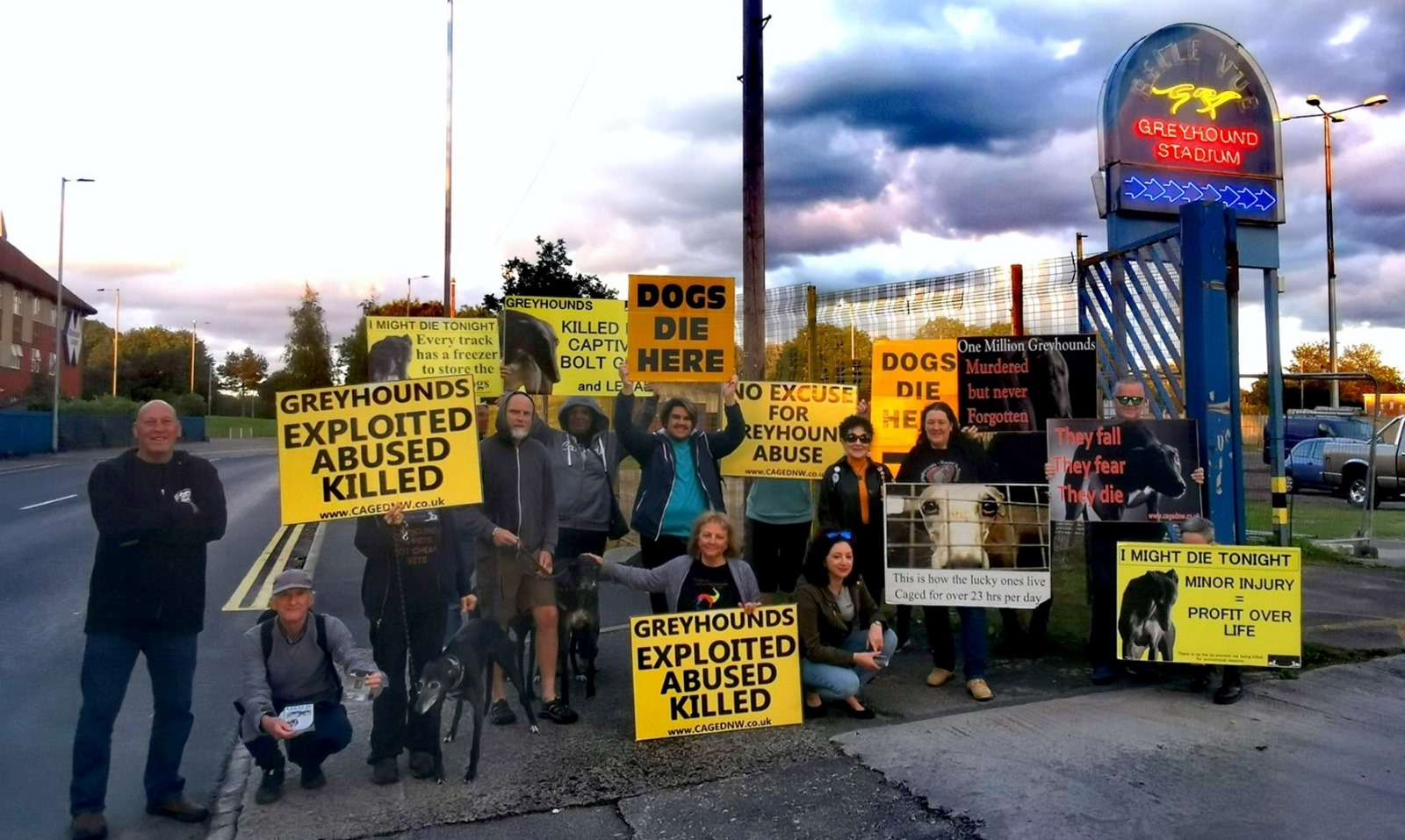
Every Saturday activists stood outside Belle Vue’s gates in the city’s famously inhospitable weather to ensure nobody could enter without knowing exactly what they were paying for: death and suffering. The campaign had been started in 2000, but it wasn’t until 2003 that Michaela found out about it and decided to join.
Michaela’s story
A committed animal-rights activist, Michaela was always out at protests, demonstrations, and outreach across the Northwest and beyond. When she found out about Belle Vue’s weekly demonstrations, it appealed to her not just because she wanted to help dogs, but because it was convenient. Protests were easy enough to get to, they were on a Saturday, and for a working woman, it was a great way to make activism fit into her life.
When she joined the campaign, she had no way of knowing what a huge part it would play in the next 19 years of her life. They caught the attention of CAGED, a nationwide anti-racing organisation, whose founders stood alongside Michaela and others, like Sue who joined in 2000, week in, week out. There were times when there were only four of them facing down thousands of racegoers, but they were there to save dogs, so they would never give up. The group grew, sometimes seeing activists join from all over England, and the weekly demos were a cornerstone of Manchester’s activist calendar. No protest, outreach, or other animal rights action could take place on a Saturday in the city without ending with the words, “are you going to Belle Vue later?” With her doorman’s headcount clicker in her hand every week, Michaela watched the entry numbers fall year after year.
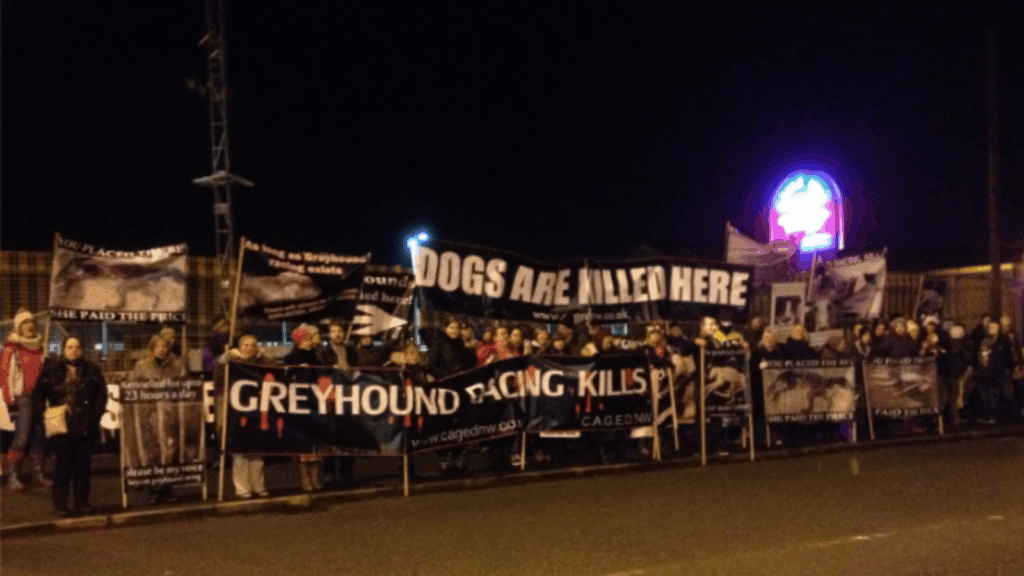
Activists from across the country would sometimes attend the protests at Belle Vue, creating a huge wall of resistance that racegoers couldn’t ignore.
What made a difference?
The same as with any other form of activism, getting through to people outside a dog track can be incredibly difficult. People often attend in large groups for birthdays, work nights out, or stag and hen parties, having secured a cheap deal for entry and thought nothing of the experience of the dogs at the track. That is, until they saw the gravestones.
Activists had painted enormous placards in the shape of gravestones, listing the names of the dogs who had lost their lives right there at Belle Vue. She saw the colour drain from people’s faces as they looked at the placards, hung their heads, left the queue and simply went home, horrified by what they almost took part in. Some didn’t feel brave enough to turn away, not wanting to cause a problem on their night out, but said to activists as they shuffled past, “I’ve got to go in, but I’ll never come back”. Seeing their impact like that is what kept Michaela and her fellow activists warm in the freezing Manchester wind and rain week after week.
“That’s it, we’ve done it.”
One day in 2019, as they were putting their placards in the back of their cars at the end of another protest, one of many local residents who had come to expect, welcome, and respect the activists approached them. That was when Michaela first laid eyes on the planning application notice that was about to change everything. The owners of the land had ended the lease for the failing attraction early, in favour of a proposed housing development. Michaela and the activists she had spent almost 2 decades standing beside were there in Manchester Town Hall on the day it was approved, Belle Vue Greyhound Stadium was to be demolished.
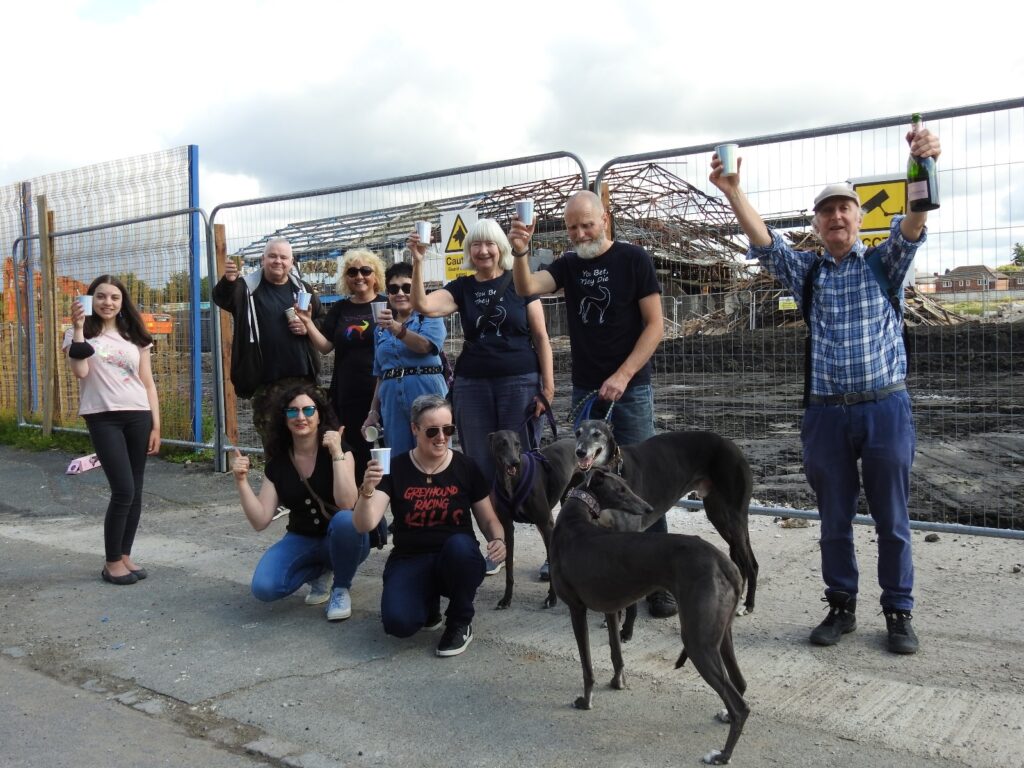
When the demolition was underway at Belle Vue, activists returned to the site to see and celebrate what they had achieved.
Every dog track has had its day
Belle Vue was the first of its kind in the UK, and it was demolished at 95 years old in 2021 after hosting cruelty for almost a century. It remains to be seen which of the 17 tracks left in England will be the last standing. Activists like Michaela stood outside Belle Vue every week for twenty years to end its reign of terror. Today we have the luxury of being able to bring down the whole industry in a matter of seconds, with just a couple of clicks on the government petition. At 100,000 signatures we can trigger a parliamentary debate where our MPs can push for a ban.
Whether we reach that target or not, we have a much easier route ahead of us than the activists at Belle Vue had. We are ending an industry that is already facing bans in Wales and Scotland, that has stadiums in enormous amounts of debt and struggling to attract visitors, and that is opposed by the majority of the public. Every remaining track in the UK has a dedicated group of activists fighting to close it, just like Belle Vue did. Those activists are doing everything they can to take a cruel industry that is already on its knees and drag it into the ground where it belongs. You can find and join your nearest group here.