
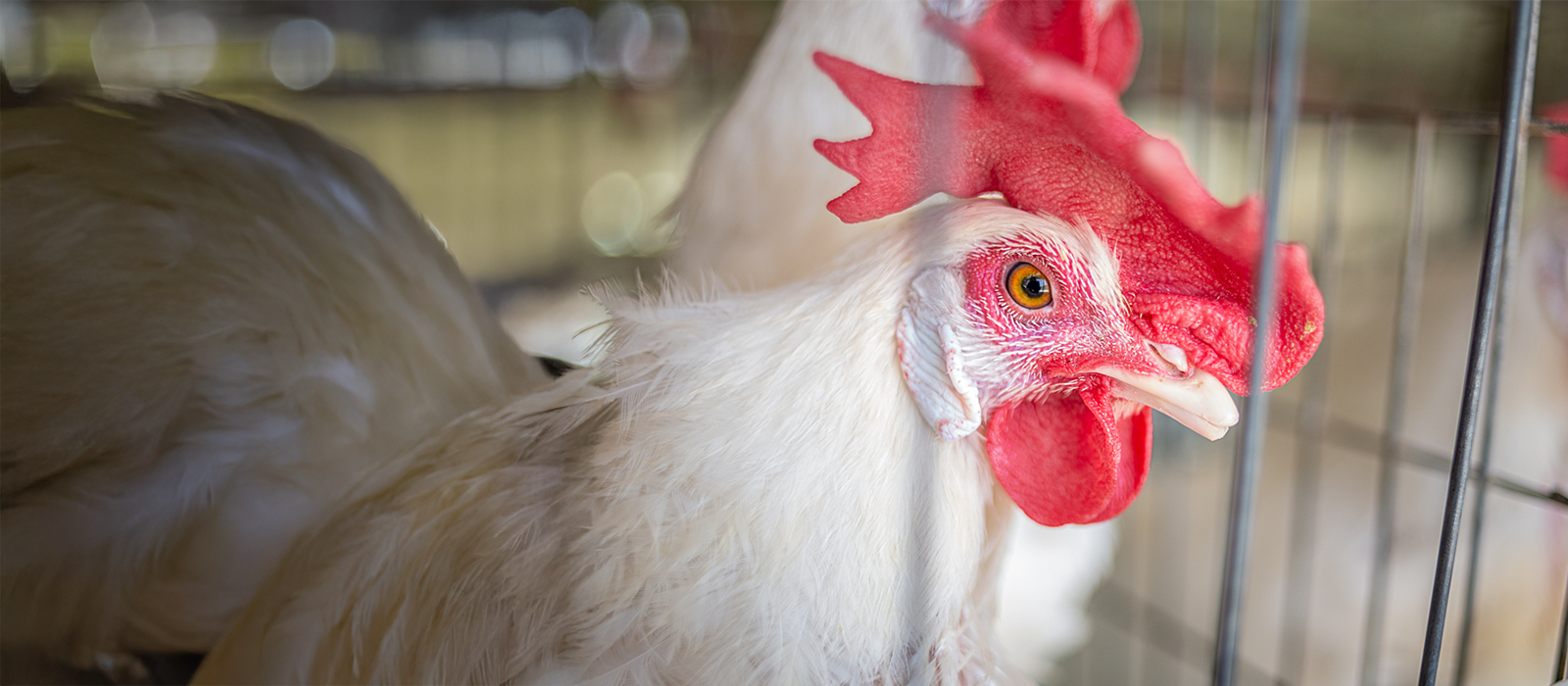
Chickens confined to the farming industry can be grouped into egg-laying hens and chickens reared for meat (known in the industry as ‘broilers’). These are two different breeds of chickens, yet both suffer equally. In the UK alone, more than 1 billion chickens are killed every year, making modern poultry farming one of the most exploitative agricultural systems in the world.
In the wild, these charming animals would spend their days dustbathing and foraging among rich undergrowth, living in groups of familiar individuals and family members. We believe that vision is possible, but first we must confront the reality.
Farming chickens for their eggs
Chickens forced into egg production will be hatched inside industrial incubators. Chicks unlucky enough to be born male are routinely killed for being economically ‘useless’ because they cannot lay eggs and are the wrong breed to be killed for meat instead. 40-45 million of these newly hatched chicks are macerated or gassed in hatcheries each year on their very first day of life. For female chicks, a lifetime of captivity and cruelty awaits…
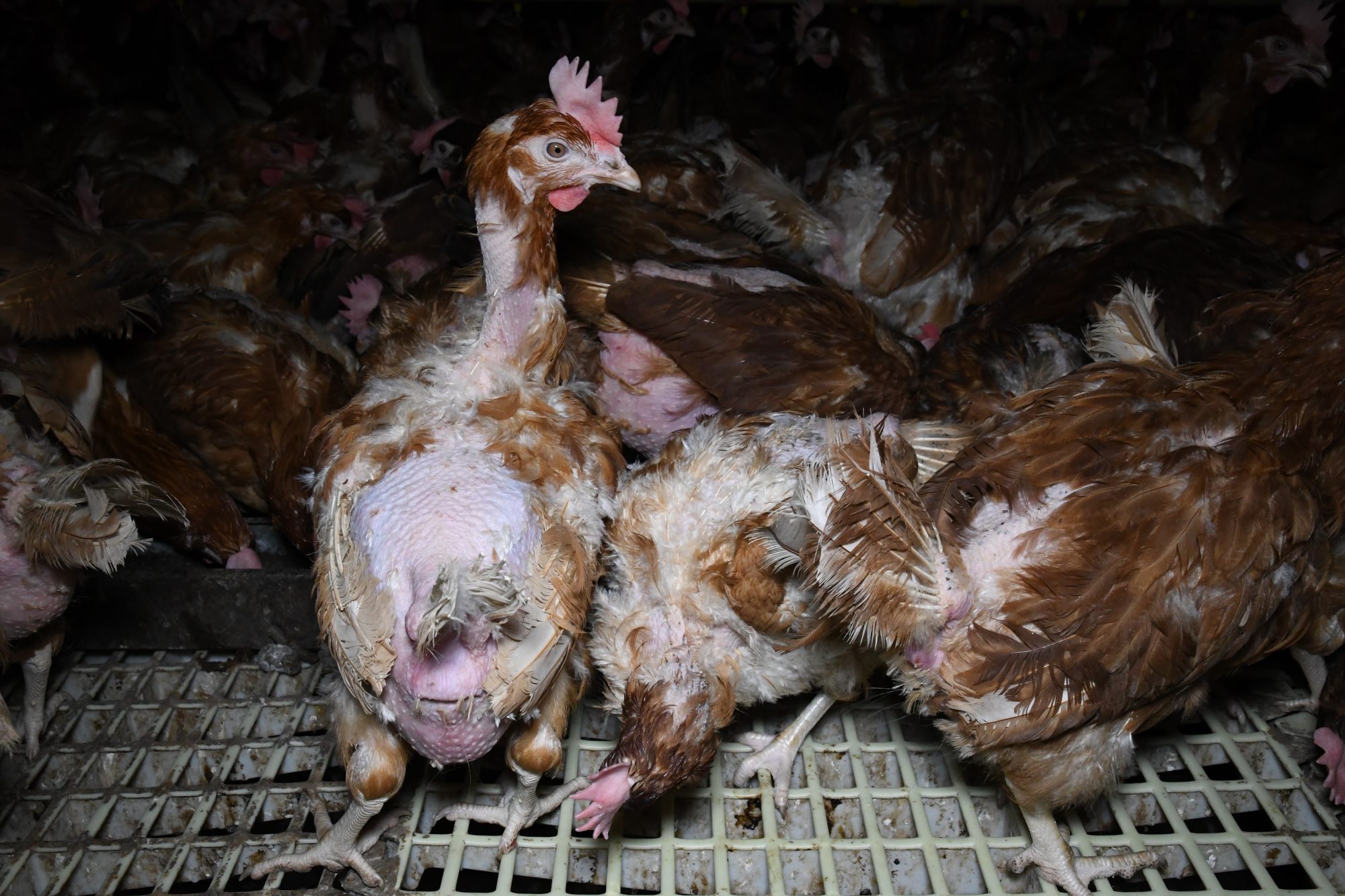
Traditional battery cages were banned across the EU in 2012 and were largely replaced by ‘enriched’ or ‘colony’ cages – but these are no better. These cages hold around 60-80 hens giving each bird 600cm2 of usable space, which is just 50cm bigger than the old battery cages. ‘Enriched’ cages fail to meet the hens’ most basic behavioural or physical needs, such as stretching her wings, scratching at the ground, or even walking and jumping.
There is nothing enriching about these enriched cages and is hugely misleading to the public who may unknowingly be buying eggs from caged hens.
Although these birds aren’t caged, conditions in barns are still very crowded and often filthy. Like caged hens, most will never see daylight instead living under artificial lighting with very little enrichment. In 2019, British Lion eggs boasted new standards of “two enrichments per 1,000 birds” which is likely to cause competition and fighting between individuals.
Free-range is wrongly considered cruelty-free – all it means is that hens must have some access to the outdoors. Access is limited to weather conditions and is usually only accessed via small pop-holes which, in huge, crowded barns, are inaccessible for many birds. This is worsened by the birds’ poor health, which can limit their ability to move around large barns and access feed, water, and the outdoors. Even on organic farms, animals can be kept in sheds of up to 3,000 birds making it impossible to ensure the wellbeing of every individual.
The wild ancestors of chickens (red jungle fowl) lay around 10-20 eggs per year. But selective breeding has forced modern breeds of egg-laying hens to produce an average of 300 eggs per year. The current goal of genetics companies is to push hens into producing at this rate for their entire lives, producing 500 eggs in total.
This takes a huge toll on their health. Birds lose calcium from their bones to help create eggshells, increasing the risk of osteoporosis and fractures. These conditions are worsened by a lack of movement in caged hens and individuals housed in very crowded barns. A build-up of excrement can also cause burns to their feet, while caged hens suffer foot deformities due to the wire flooring.
Like all farmed animals, egg-laying hens are subject to mutilations. Stressful environments can lead to frustration behaviours such as pecking at other chickens, feather pulling and even cannibalism. Instead of improving conditions, the industry chooses to ‘debeak’ chicks whilst in the hatchery, regardless of whether they are destined for cages, barns, or free-range systems. Debeaking (known as ‘beak trimming’ by the industry) was once done using a red hot blade but now an infrared beam is used yet research has shown that both methods cause acute pain. There is no requirement for anaesthetic to be used.
Regardless of how egg-laying hens are housed, whether its caged, free-range, barn or organic, all will be sent to slaughter when their bodies can no longer cope with the industry’s high demand for eggs. At around 72 weeks of age, they are sent to slaughter and turned into cheap meat products, like pies or dog food.
Egg labelling lies
‘Free range’ does not equal a good life. Not only will ‘free-range’ hens still spend most of their lives indoors and be subject to painful mutilations, diseases and injuries, but accreditation schemes and audits have always failed animals – and always will.
In 2016, Animal Aid found injured and bloodied turkeys at a free-range, RSPCA Assured farm that was supplying the likes of Lidl, Marks & Spencer and the Co-Op. Another exposé of a chicken farm in Somerset – whose products also carried the RSPCA Assured label – found chickens starving to death because agonising leg and hip injuries prevented them from reaching feed and water stations.
Egg labelling has been mandatory since 2004 to allow consumers to make higher welfare choices, but it hasn’t improved life for these chickens.
Take action for chickens
Killing an animal can never be considered humane because animals' lives are as important to them as ours are to us. Take action today for a kinder tomorrow.