

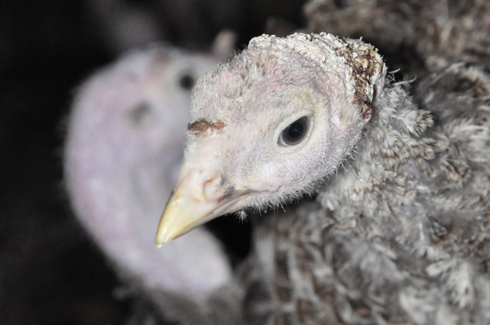
Turkeys are intelligent and sensitive animals. With more than 20 distinct vocalisations they create lasting bonds with other turkeys, and experience emotions just like us – in fact, the colour of their heads can change from red to blue to white, depending on their mood! Despite this, turkeys, endure nightmarish conditions on farms. They are subject to painful mutilations, crammed into windowless sheds, and forced to grow so quickly that they cannot stand – and this isn’t only for Christmas. In fact, more than 15 million are slaughtered in the UK throughout the year.
Turkeys are almost exclusively bred using artificial insemination. This is because modern breeds have been selectively bred for such fast growth that their breast muscles are simply too large to allow the male to get close enough to the female. Breeding birds are then housed indoors: Department for Environment, Food and Rural Affairs (Defra) stipulates that male turkeys only require 1m2 of space, while hens are given even less at just 345cm2 per bird. These curious, playful animals are denied the ability to perform any natural behaviours, such as exploring, foraging or socialising.
The process of artificial insemination is stressful for both male and female turkeys. Semen collection is carried out manually, usually by clamping the bird’s legs and restraining him upside down, sometimes as often as twice a day. Once the female turkeys are caught – a stressful process in itself – they are similarly restrained upside down and roughly handled. The process involves inserting a plastic straw or syringe into her abdomen and is nothing short of assault. Hens have been seen flapping their wings in panic and attempting to escape.
In natural conditions, the mother would communicate with her babies (known as ‘poults’) while still in the egg, but in commercial turkey farming, she will never meet her babies. Instead, fertile eggs are transferred to a hatchery while the hens – along with the males – will be sent to slaughter once they are ‘spent’ and no longer useful.
After 28 days in industrial incubators, turkey ‘poults’ are hatched and transported to large, purpose-built sheds where up to 25,000 turkeys can be housed together.
Many young birds cannot find food and water without the guidance of their mothers and will die from starvation or heat stress. As the birds grow bigger, space reduces and ‘waste’ begins to build up, causing ammonia burns and ulcers on their legs and breasts as well as conditions like footpad dermatitis. Just like the farming of chickens for meat, these barns are not cleaned or changed until the birds are sent to slaughter, between 12 and 26 weeks of age.
Turkeys are not naturally aggressive, but barren, overcrowded conditions can lead to frustration behaviours such as feather pecking and cannibalism. In response, the mutilation of young turkeys is now a standard industry practice endorsed by government guidelines: beak trimming, toe cutting and de-snooding (a snood is the fleshy appendage that folds over the beak) are carried out to prevent injuries and reduced carcass value. Like all mutilations of farmed animals, these can lead to open wounds, blood loss, reduced activity and feeding, and chronic pain as well as risk of infection.
You may have heard of ‘pole barns’ which are the exact same as the barns described above, but with natural daylight and ventilation due to the upper walls being open. Conditions are still overcrowded and stressful without opportunity to express natural behaviours. Even ‘free range’ turkeys can be housed indoors for the entirety of the winter months and may also be subjected to the same mutilations.
Modern turkey breeds grow to four times the size of their wild ancestors. Reared to be pathologically obese, the sheer weight of their own bodies puts enormous stress on their musculoskeletal system, causing lameness, deformities, joint pain and skin lesions from being unable to move. Combined with flooring that is sodden with excrement and urine, these sheds are a hotbed for infectious diseases. Each year, more than 1 million turkeys die in these sheds.
To keep them alive long enough to make money (by reaching slaughter weight) turkeys can be fed antibiotics and other drugs for the entirety of their too-short lives, whether or not they are sick (only ‘organic’ farms use antibiotics as treatment rather than prevention). This is contributing to the creation of antibiotic-resistant bacteria: a serious threat to global human health whereby antibiotics no longer work for some life-threatening diseases.
Slaughtering turkeys
Turkeys have a natural lifespan of around 10 years, but modern farming means they’re slaughtered at just 12-26 weeks of age. Turkeys are slaughtered the same way as chickens, either by gassing or by electrical stunning followed by cutting their throat – both methods that cause immense suffering.
80% of poultry in the UK, including turkeys, will be gassed to death. This involves their transport crates being exposed to a lethal mixture of air and gas until the birds are dead. Like chickens, turkeys will gasp for air and shake their heads in distress because this is not an instantaneous death.
The alternative method involves shackling the birds by their feet to a conveyor belt, which moves them through an electrified water bath (intended to stun them) followed by a mechanical blade which cuts their neck. However, some birds will panic and lift their heads away from the water baths so are not stunned. The mechanical blade can also miss birds entirely. If this happens, they will be boiled alive in the next stage of the process, which involves scalding hot water tanks used to loosen the feathers ready for processing.
Take action for turkeys
Killing an animal can never be considered humane because animals' lives are as important to them as ours are to us. Take action today for a kinder tomorrow.